Why Word Processors Fail Complex Revision
Word processors were designed for linear document generation, not structural transformation. When revising a book-length manuscript (60,000 to 120,000 words), an author or editor faces severe cognitive fragmentation:
- Invisible Cascading Effects: Changing a character's motivation in Chapter 4 silently invalidates dialogue cues and emotional tension in Chapters 9, 14, and 22.
- Flat Document Blindness: A scrolling text canvas provides no structural overview of narrative momentum, rhythm shifts, or thematic density across the total narrative arc.
- Destructive Experimentation: Testing three alternative endings requires duplicating sprawling files or cluttering margins with ambiguous track-changes comments.
"How do we give writers the structural rigor of a modern software IDE without turning prose into an engineering spreadsheet?"
Deterministic Manuscript Chunking
Revision Atlas treats a manuscript as a hierarchical graph rather than a monolithic stream of text. The ingestion pipeline parses standard Markdown, plain text, and structured DOCX files into discrete, addressable units.
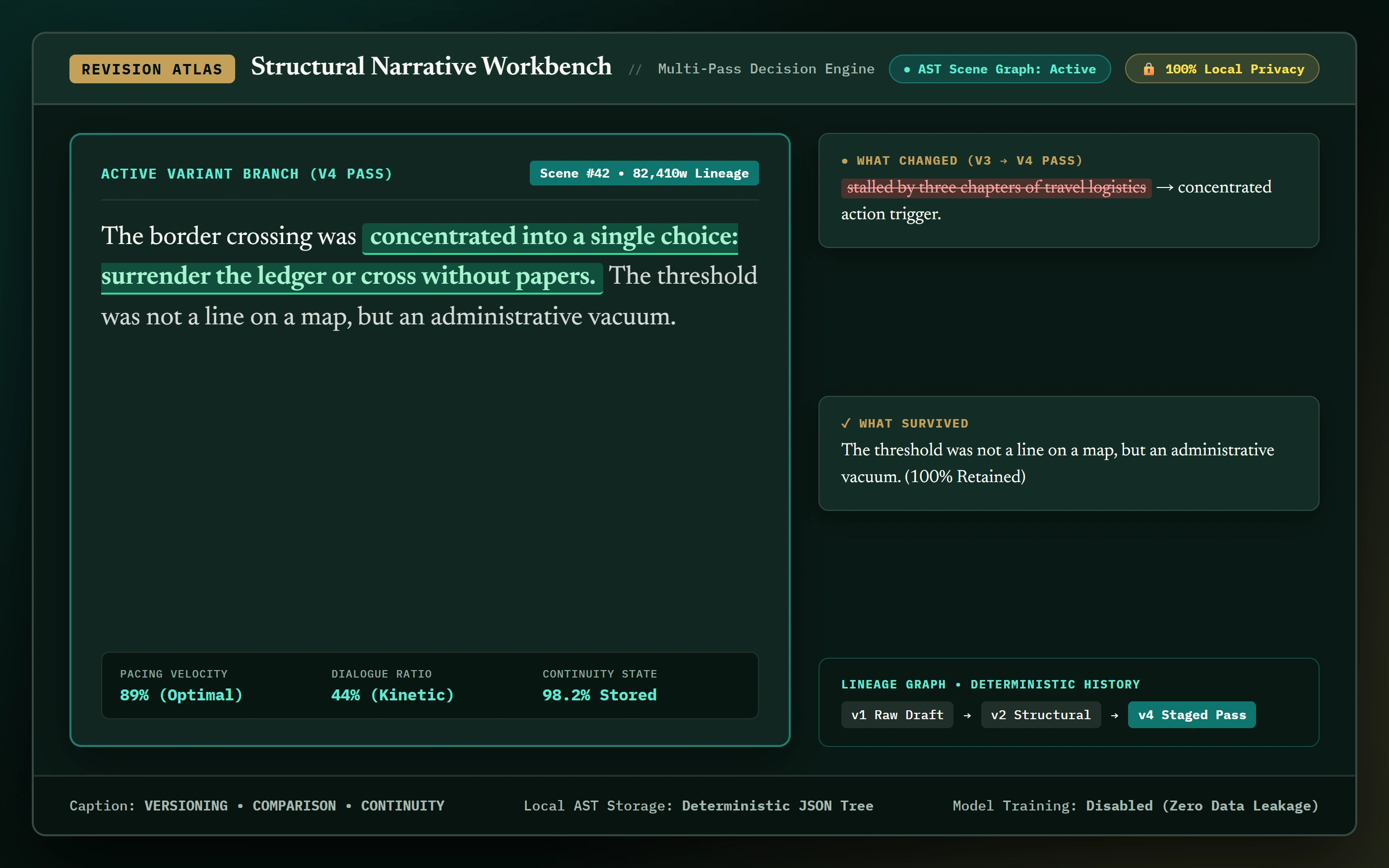
Every scene node maintains an immutable content hash. When edits occur, the system records localized deltas rather than rewriting the manuscript, enabling infinite branch histories without data corruption.
Pacing, Density, and Motif Tracking
Rather than vague subjective feelings about whether the middle of a book "drags," Revision Atlas extracts deterministic telemetry from the prose:
This diagnostic feedback is purely descriptive rather than prescriptive. The system never dictates how a writer should write; it illuminates what is already occurring on the page.
Non-Destructive Variant Drafting
A central innovation in Revision Atlas is the Variant Workbench. When an editor wishes to experiment with restructuring a crucial scene, they do not duplicate the file. Instead, they spin off a lightweight variant branch attached directly to that scene node.
Privacy & Authorial Autonomy
Creative manuscripts represent irreplaceable personal and commercial intellectual property. Revision Atlas was architected with strict boundary principles:
- Local-First Storage: Manuscript drafts remain in private local storage or encrypted repositories.
- No Automated Ghostwriting: The engine provides architectural clarity, indexing, and comparison tools—not generative auto-completion or algorithmic rewrites.
- Zero Data Exhaust: No manuscript content is ever transmitted to commercial AI training pipelines.